
Engaging with Community


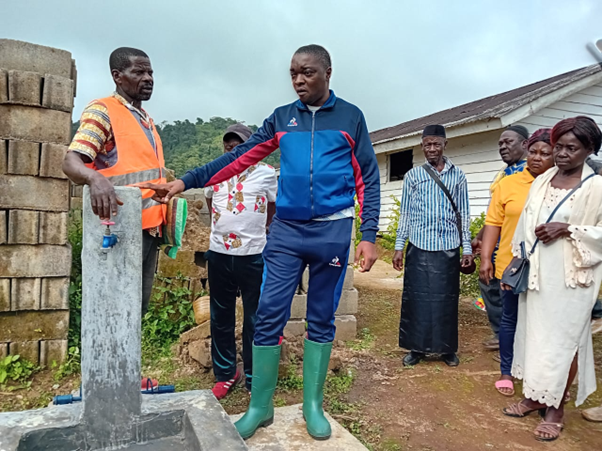
Committed to the enhancement of community local livelihood, BNP constructs and rehabilitate Six (06), community projects in the SE cluster of BNP.
Introduction

Bakossi National Park is located in the Kupe-Muanenguba Division with headquarters in Bangem. Kupe-Muanenguba is divided into three subdivisions (Bangem, Tombel and Nguti). The main ethnic groups of the Division are Bakossi, Mbo, and Balong. The Bakossi are the largest member of a linguistic group often referred to as the Mbo group (Hedinger, 1987) comprising about 70.000 people found in and around the BakossiNational Park. They have a mystical origin as the descendants of the founder ancestor and tribal hero, Ngoe, (literally meaning Leopard) who is buried in planted secret grove Muekan Village in the Bakossi Mountains.The tribes that developed from the sons of Ngoe include, the Bakundu, Balue, Bafaw, Bakem, Bonkeng, Baloundu, Bassosi, Mbo, Balung, Miamillo, Muamenam, Bakaka, Mimie, Manehas, and Baneka, inhabiting lands neighboring the Kupe-Muanenguba in Southwest and Littoral Provinces.
|
The foundation and distribution of these ethnic groups in the densely forested interior of coaster southwest Cameroon were probably formed during the early to mid19th century, a period of extensive tribal warfare, displacement and migration. They are interested in their social and political institutions and in their art forms. The main religion is Christianity. Catholic (Roman Catholic Church) and the Protestants (Presbyterian and Baptist Church) are the dominant Christian churches, but small groups of persons belong to sect churches (Jehovah Witnesses, Apostolic Faith, Apostolic church, Full Gospel, Deeper Life, Lutheran and Anglican…..) are found in the area.
Close to the BNP is the famous twin Kupe-Muanenguba lakes. The twin lakes are considered from time past as the pride of the people. These lakes are believed to be source of ancestral power to the people, and its beautiful scenery has always attracted people from worldwide to visit the area.
The main economic activity of the people is farming. More than 75% of the rural community are involved in food and cash crops production. Main cash crops include cocoa and coffee. Other important activities include NTFPs gathering, hunting, fishing, and petty trading.In the Bakossi area, collection of amphibians, in particular, the goliath frog, other frogs and tadpoles for consumption and as a protein is an important livelihood activity (Gonwouo and Rödel, 2008).
Community Participation in Conservation
Cluster Conservation & Development Agreements (CCDAs): Signed with local communities to define rights, responsibilities, and benefits of conservation.
Community Surveillance Teams: Former hunters and village forest management committees help monitor the park, dismantle traps, and report illegal activities.
Environmental Education: Awareness campaigns and school programs empower youth to see themselves as future custodians of the park.
Alternative Livelihoods for Former Hunters
To reduce hunting pressure and provide sustainable income, the park and its partners support new livelihoods:
Beekeeping: Over 300 beehives installed, with training for former hunters to produce and sell honey.
Piggery: Repentant poachers trained in modern pig farming, provided with pigsties, piglets, and feed.
Vocational Training: Skills such as construction, carpentry, mechanics, ICT, hotel catering, and electricity taught in Buea to open new career paths.
Community Farming: White pepper farms established in 20 communities, creating revenue while reducing reliance on hunting and logging.
Cultural Heritage & Identity
The Bakossi people trace their ancestry to Ngoe (the Leopard), and their sacred landscapes like the Kupe-Muanenguba twin lakes and Muandelengoh rocks are living expressions of this heritage.
Visitors can engage with local communities through storytelling, music, dance, and rituals, experiencing how culture and conservation come together.
Respecting cultural sites ensures that tourism supports both spiritual traditions and biodiversity protection.
Benefits of Community Engagement
Strengthens trust and cooperation between the park and local people.
Provides sustainable income while reducing dependence on poaching and deforestation.
Preserves traditional knowledge and heritage for future generations.
Creates a sense of shared responsibility for protecting nature.